METHOD / COFFEE
VARIATIONS: 1
French Press
Full immersion with mesh filter. Full body and oils.
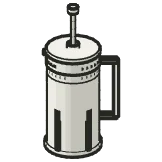
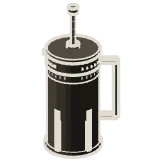
Optional: get to know each piece of the bench before you start.
A glass beaker in a metal frame with handle and spout. Coffee and water steep together until it is time to serve; there is no paper filter.
[01]How the french press works
The french press is full immersion: coffee and water stay in contact the whole time, and the metal mesh filter lets through the oils and fine particles that paper would hold back. That is what gives the signature dense body — and it is the most forgiving method there is, because immersion extraction is self-limiting.
With no pour to manage, only four parameters remain: grind, ratio, temperature and time.
[02]Grind, ratio and temperature
Medium-coarse, 1:15 to 1:17, water at ~94°C. The belief that french press demands a very coarse grind comes from trying to compensate for sludge — but grinding too coarse just brews thin, watery coffee. Better to grind medium-coarse and solve the sludge with technique: pour gently and leave the fines at the bottom.
[03]The house recipe
Hoffmann’s method attacks the french press’ biggest flaw — excess sediment — without losing body: a 4-minute steep, break the crust, skim the foam and floaters with a spoon, then rest a few more minutes before serving. The plunger goes down only to the surface, acting as a sieve, never to the bottom. Patience instead of force.
[04]Common mistakes
Plunging all the way down and stirring up sediment that had already settled; serving too early, with fines still in suspension; leaving brewed coffee sitting in the press — it keeps extracting and turns bitter; and pouring boiling water straight onto a dark roast, which turns harsh. Decant whatever you are not serving right away.